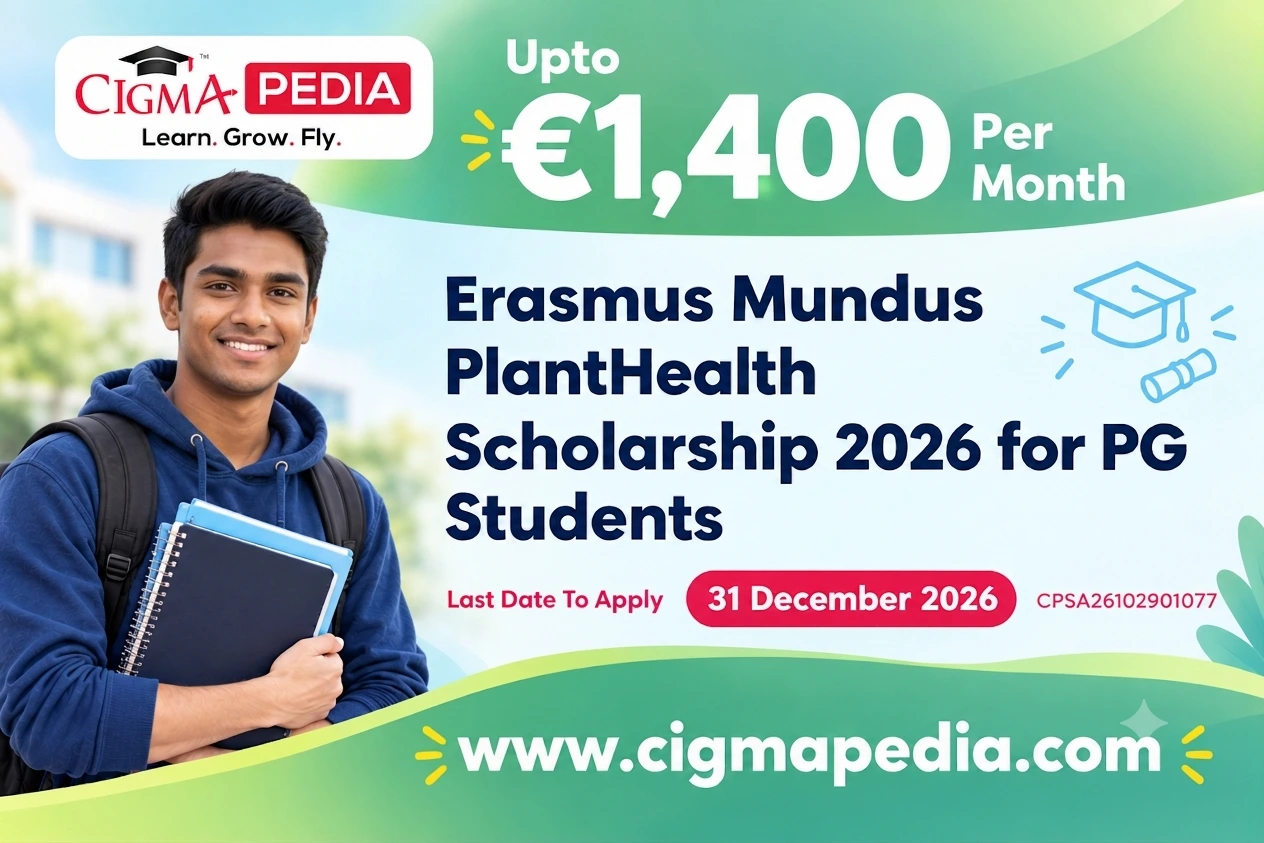



Erasmus Mundus PlantHealth Scholarship 2026 for PG Students : It offers an exciting opportunity for international students who aspire to pursue a master’s degree in Plant Health and Sustainable Cropping Systems at leading European universities. Supported by the European Commission under the Erasmus+ programme, this scholarship aims to develop skilled professionals, researchers, and scientists who can contribute to global food security, sustainable agriculture, and environmentally responsible crop protection. With tuition fee coverage, a monthly allowance, and opportunities to study in multiple European countries, the programme provides an international learning experience for students seeking to build careers in agricultural sciences and plant health.
The Erasmus Mundus Joint Master (EMJM) in PlantHealth brings together four renowned European institutions: the Universitat Politècnica de València in Spain, the University of Padova in Italy, the University of Göttingen in Germany, and Institut Agro in France. Students can gain exposure to advanced research, practical agricultural techniques, and international approaches to plant protection and sustainable cropping systems.
Eligibility Criteria for Erasmus Mundus PlantHealth Scholarship
Applicants should review the following eligibility requirements before beginning the application process.
- Nationality: Students from all countries are eligible to apply, provided they satisfy the programme’s admission requirements.
- Academic Qualification: Applicants should hold a Bachelor of Science degree equivalent to 180 European Credit Transfer and Accumulation System (ECTS) credits in Agronomy, Agricultural Sciences, or a related discipline.
- Relevant Coursework: Applicants must have completed at least 4 ECTS credits in Plant Health or Crop Protection, or possess equivalent academic preparation.
- English Language Proficiency: Applicants must meet the programme’s English language requirement at the B2 level under the Common European Framework of Reference for Languages (CEFR). Applicants should check which language certificates and exemptions are accepted.
- Recommendation Letters: Two reference letters must be included in the application.
- Previous Erasmus Mundus Scholarship: Applicants who have previously received an Erasmus Mundus Joint Master scholarship are not eligible under the conditions described in the supplied information.
- Complete Application: Applicants must submit all required documents and provide accurate information through the online application system.
- Academic Suitability: Applicants should demonstrate that their previous studies are relevant to plant health, crop protection, agronomy, agricultural sciences, or another accepted related field.
Meeting the minimum eligibility requirements does not guarantee admission or scholarship selection. Applicants should also review the programme’s academic selection criteria and any additional requirements specified for the 2027–29 intake.
Also Check : Learn Pro Photo Editing With Photoshop Illustrator Lightroom Canva 2026 (Free Udemy Course)
Benefits of Erasmus Mundus PlantHealth Scholarship
The scholarship is designed to reduce the financial burden of international postgraduate study while giving selected students access to a specialised European master’s programme.
- Full Tuition Fee Coverage: The scholarship covers 100% of the tuition fees for the eligible duration of the programme, according to the supplied information.
- Monthly Allowance of €1,400: Selected scholarship recipients are stated to receive €1,400 per month for up to 24 months to support travel, visa, installation, and living expenses. Applicants should verify the applicable payment arrangements and funding conditions in the official scholarship terms.
- Support for Travel and Relocation: The monthly allowance is intended to help students manage expenses associated with travelling to Europe and relocating between study destinations.
- Visa and Installation Expenses: The allowance is intended to help students meet visa-related and initial settlement costs, subject to the official funding conditions.
- Insurance Coverage: The supplied information states that full insurance coverage is included. Students should check the precise scope of insurance and any exclusions in the scholarship agreement.
- Mandatory Academic Costs: The programme information indicates coverage of mandatory academic costs. Applicants should verify which specific fees and expenses are included.
- International Study Experience: Students can study at participating European universities and experience different academic environments, research facilities, and agricultural systems.
- Potential for a Double Diploma: The programme information describes an opportunity to obtain a double diploma. The exact qualification awarded depends on the approved study pathway and applicable academic requirements.
- Access to Research Facilities: Students can gain experience through laboratory work, field studies, and research projects relevant to plant health and crop protection.
- Professional Networking: Students can connect with international researchers, professors, fellow students, and professionals working in agriculture and sustainability.
- Practical Learning Opportunities: Professional internships and fieldwork can help students apply scientific knowledge to agricultural challenges and develop industry-relevant skills.
Documents Required for Erasmus Mundus PlantHealth Scholarship
Applicants should prepare the following documents in advance. The exact document list, accepted formats, and translation requirements should be checked on the official application portal.
- Curriculum Vitae (CV): A clear, updated CV outlining educational qualifications, relevant coursework, research experience, internships, technical skills, publications, and other relevant achievements.
- Degree Certificate: A copy of the bachelor’s degree certificate. Applicants who have not yet graduated should check whether a provisional certificate or official confirmation of expected graduation is accepted.
- Academic Transcripts: Official academic records showing completed courses, grades, credits, and other information required to assess academic eligibility.
- English Language Proficiency Proof: An accepted certificate or other evidence demonstrating English proficiency at the required B2 level, unless the applicant qualifies for an officially recognised exemption.
- Declaration on Honour: The declaration required by the programme, completed and signed according to the official instructions.
- Two Recommendation Letters: Reference letters from suitable academic referees or other individuals accepted by the programme. Applicants should follow the prescribed format and submission procedure.
- Other Relevant Documents: Any additional documents requested by the programme, such as identification, a motivation statement, evidence of relevant coursework, or certified translations, if applicable.
Before submitting the application, applicants should ensure that documents are readable, complete, correctly named, and consistent with the information entered in the application form.
How to Apply for Erasmus Mundus PlantHealth Scholarship
Follow these steps to apply for the scholarship:
- Click on the “Click Here To Apply” button provided at the end.
- Carefully review the scholarship details provided.
- Complete the application form and ensure all required information is accurately filled out.
- Attach the necessary documents as specified in the scholarship requirements.
- Finally, click the “Submit” button to submit your scholarship application.
Last Date to Apply
The last date to apply is 31 December 2026
Contact Details
For any queries please contact planthealth@upv.es
Top 5 Common Mistakes While Applying for Scholarship and How to Avoid Them
1. Applying Without Checking the Academic Credit Requirements
Common mistake: Applicants may assume that any bachelor’s degree in agriculture automatically satisfies the eligibility criteria. However, the stated requirements include a relevant degree equivalent to 180 ECTS credits and at least 4 ECTS credits in Plant Health or Crop Protection, or equivalent preparation.
How to avoid it:
- Review the official eligibility criteria before beginning the application.
- Examine your transcript to identify relevant courses and credits.
- Obtain an official course description or supporting document if your relevant coursework is not obvious from your transcript.
- Contact the programme admissions team if you are unsure whether your degree or credits are considered equivalent.
2. Submitting Incomplete or Incorrect Documents
Common mistake: Applicants may forget a required document, upload an unreadable file, submit an unofficial transcript when an official one is required, or overlook translation requirements.
How to avoid it:
- Prepare a checklist of every document required by the official application portal.
- Verify the accepted file formats, file-size limits, and naming conventions.
- Check that your degree certificate and transcript contain all necessary pages.
- Arrange translations or certification well in advance when required.
- Open every uploaded file before submission to confirm that it is readable.
3. Failing to Meet the English Language Requirement
Common mistake: Applicants may assume that previous education in English automatically satisfies the B2 requirement or submit a language certificate that the programme does not accept.
How to avoid it:
- Confirm the accepted English language certificates and minimum scores on the official website.
- Check whether exemptions are available and what evidence is needed.
- Allow sufficient time to take an accepted language test if necessary.
- Ensure that any certificate submitted remains valid under the programme’s rules.
4. Submitting Weak Recommendation Letters
Common mistake: Applicants may request references at the last minute or submit generic letters that do not explain their academic preparation, research ability, or suitability for plant health studies.
How to avoid it:
- Approach suitable referees early.
- Choose individuals who can provide specific examples of your academic performance, research skills, or relevant experience.
- Share your CV, transcript, programme details, and application deadline with your referees.
- Confirm whether letters must be uploaded by applicants or submitted directly by referees.
- Verify that both required reference letters have been received in the prescribed format.
5. Waiting Until the Final Day to Submit the Application
Common mistake: Applicants may delay submission until 31 December 2026, leaving little time to address technical issues, missing documents, or unexpected requests.
How to avoid it:
- Work backwards from the official deadline and set personal deadlines for each document.
- Prepare your CV, transcripts, language evidence, and references in advance.
- Submit early enough to correct errors if the portal identifies missing information.
- Save your submission confirmation and check your email for any follow-up instructions.
- Verify the official deadline and time zone rather than assuming that submission remains open until midnight in your own location.
Frequently Asked Questions (FAQs)
Q1: Can final-year undergraduate students apply for the Erasmus Mundus PlantHealth Scholarship 2027–29?
Final-year undergraduate students should check the official admission rules to determine whether they can apply before completing their bachelor’s degree. The supplied eligibility information specifies a relevant bachelor’s degree equivalent to 180 ECTS credits, but it does not establish whether applicants awaiting graduation may submit an application. If provisional admission is permitted, the programme may require an official expected-graduation certificate and proof of degree completion by a specified date. Applicants should confirm the relevant conditions with the admissions team before applying.
Q2: Is the €1,400 monthly allowance paid in addition to tuition fee coverage?
According to the supplied scholarship information, the scholarship covers the full tuition fees and provides a monthly allowance of €1,400 for up to 24 months. These are separate stated components of the financial support. The allowance is intended to help with travel, visa, installation, and living expenses. However, the exact payment schedule, eligibility conditions, and any deductions or other restrictions must be confirmed in the official scholarship agreement. Applicants should not assume that every possible expense is separately reimbursed.
Q3: Do applicants need previous professional experience in agriculture or plant research?
The supplied eligibility criteria do not state that professional work experience is compulsory. The primary academic requirements are a relevant bachelor’s degree, the required preparation in Plant Health or Crop Protection, English proficiency at B2 level, and two recommendation letters. Nevertheless, relevant internships, laboratory experience, research projects, or agricultural activities may help applicants demonstrate their interest and suitability for the programme if these experiences are considered during selection. Applicants should check the official selection criteria to understand how academic and professional experience are assessed.
Q4: Can students choose which European universities they will attend during the programme?
The supplied application instructions indicate that applicants can state their preferred mobility scheme and universities for the first and second years. However, this does not necessarily mean that every preference will be approved. Available pathways, academic requirements, programme arrangements, and institutional decisions may affect the final placement. Applicants should carefully review the mobility options published for the 2027–29 intake and select their preferences according to their academic interests and the programme’s instructions.
Q5: What can graduates do after completing the PlantHealth master’s programme?
Graduates may pursue careers related to plant pathology, crop protection, agricultural research, sustainable farming, pest management, agricultural biotechnology, and environmental sustainability. Depending on their specialisation and experience, they may seek opportunities with research institutes, universities, agritech companies, agricultural advisory services, plant protection organisations, or public and private agricultural projects. The degree may also provide a foundation for doctoral research or further specialised training. Actual employment opportunities depend on the graduate’s skills, experience, local employment conditions, and any professional or immigration requirements in the country where they intend to work.
Also Check : Warwick Chancellor’s International Scholarships 2027 for PhD Students
Overview of Erasmus Mundus PlantHealth Scholarship
| Scholarship id | CPSA26102901077 |
| Scholarship Name | Erasmus Mundus PlantHealth Scholarship 2026 for PG Students |
| Scholarship Open for | Boys & Girls |
| Scholarship Offered by | European Commission under the Erasmus+ Programme |
| Who can Apply ? | International students with a Bachelor of Science degree (180 ECTS) in Agronomy, Agricultural Sciences, or a related field, meeting Plant Health or Crop Protection and B2-level English requirements. |
| Location of Students eligible | Worldwide |
| Scholarship Benefits | Upto €1,400 Per Month |
| Last Date to Apply | 31 December 2026 |